
Can Your Manual Gate Be Automated? Here’s What Decides It

It’s raining. You’re idling in your own driveway, headlights on a gate that won’t open itself, and the only way through is to get out, walk into the wet, drag the thing back, then climb in again. Most people land on the same thought eventually. Surely this could open on its own.
It usually can. The motor is rarely the hard part. What decides if your manual gate can be automated, and what the job costs, is the gate itself and the few metres of ground around it. Some gates are ready tomorrow. Some need work first. A few are better off replaced.
It Usually Comes Down to the Gate Itself
Start with the gate, because almost every decision follows from it.
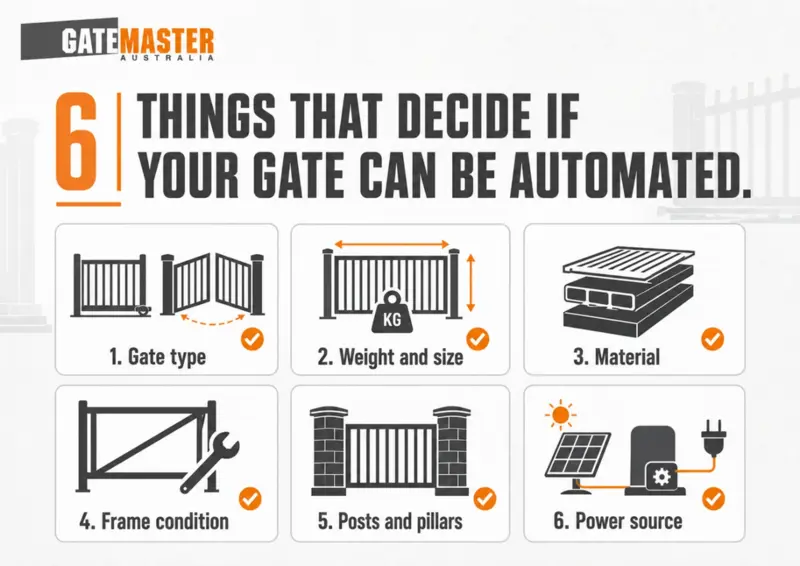
Type comes first. A swing gate, a sliding gate and a cantilever gate each ask for a different gate motor and a different setup. After that, it’s weight and size. Every motor is rated to move a gate up to a certain mass and length, and a heavy timber or wrought-iron gate narrows your options quickly.
Then there’s the material and the shape it’s in. Steel, aluminium and timber all automate fine when they’re sound. Condition is the catch. A gate that sags on its hinges, has rusted through near the base, or has racked out of square will fight any motor you bolt to it. Automation doesn’t fix a tired gate. It just runs a tired gate back and forth until something gives.
This is where plenty of retrofits quietly turn into rebuilds, and where having the gate built and matched to the motor in one place saves a second round of work.
What’s Around the Gate Matters Just as Much
A good gate on bad surroundings still won’t work, and it’s the part people forget when they price up the job.
Look at the posts and pillars first. They carry the gate’s weight and the motor’s load every day, and a post that’s perfectly fine for a hand-pushed gate can be undersized once a motor is pushing. Brick pillars, timber posts and steel posts all have limits worth checking before anything gets mounted.
On a swing gate, the hinges and pivots do quiet, constant work, so any wear there shows up fast once a motor is involved. On a sliding gate, the rolling surface and track have to sit level and stay clean along the whole run. Then there’s the ground. A driveway that slopes uphill into a swing gate can stop it opening at all, and a slope under a slider changes the whole approach.
Clearance is the last piece. A swing gate needs the arc to swing into. A slider needs room to one side to run off. And the gate needs power within reach, either mains or a solar setup for blocks without easy cabling.
Swing or Sliding? The Automation Isn’t the Same
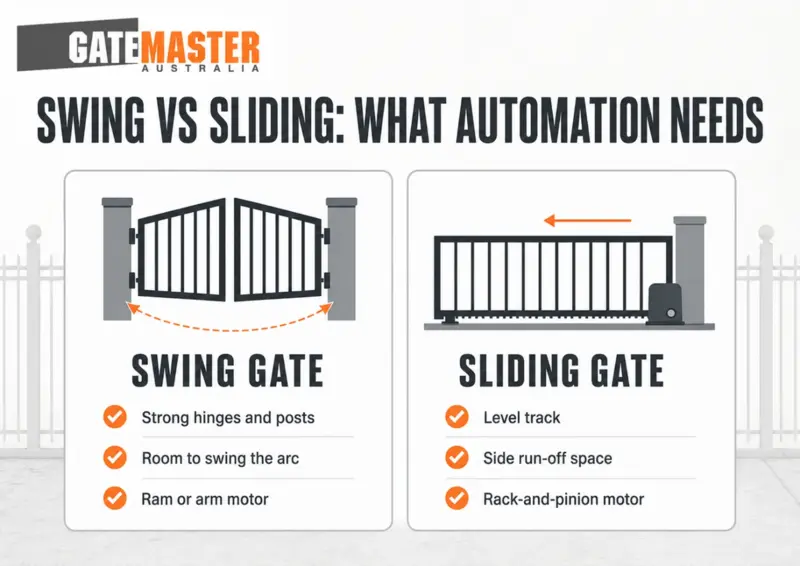
The two common gate types automate along different lines, and the right automatic gates setup depends on which one you’ve got.
A swing gate runs on a ram or an articulated arm at each hinge, so the posts and hinges carry the strain and the gate needs clear space to swing through. Tight driveways and uphill slopes are the usual headaches.
A sliding gate runs on a rack-and-pinion motor along the bottom, so a level track and clear run-off space beside the opening matter far more than swing room. Cantilever gates skip the ground track entirely and hang off a counterbalanced frame, which suits rough or flood-prone ground but needs space behind the opening for the tail to sit.
When It Isn’t a Simple Retrofit
Here’s a test you can run yourself. Unlatch the gate and push it by hand. If it glides, light and smooth, a motor will have an easy time, and a DIY automation kit is a fair weekend job for confident hands.
If it’s heavy, catches halfway, or drifts back on its own, a motor will struggle in exactly the spots you do, and that’s the moment to have it looked at rather than forced. Undersized posts, a gate out of square, a steep approach, or a gate that’s simply too big for a bolt-on kit all point the same way. It’s the same logic behind well-built electric gates: the gate has to be right before the power goes on.
Safety sits underneath all of it. A powered gate is a machine, and motors sold here are built to AS/NZS 60335.2.103, which means they have to sense an obstruction and stop or reverse before anyone gets hurt, backed by photo beams across the opening. Set up properly, that protection runs on its own. Skipped to save a few dollars, it becomes a real hazard.
Talk to Us Before You Commit
Not sure which camp your gate falls into? That’s normal, and it’s a quick thing to settle. Send through a photo or a few measurements and we’ll tell you straight: ready for a motor, needs a tune-up first, or better off rebuilt. For gate automation in Perth, our team designs, supplies and installs from our Maddington workshop. You can see our recent automatic driveway gates in Perth in the gallery, and there’s DIY guidance if you’d rather take on a straightforward gate yourself.