
ROI of Sustainability: How Solar Gates Reduce Long-term Operational Costs for Perth Businesses
For many Perth businesses, commercial automatic solar gates are less about image and more about cost control. In a city with strong year-round sun, a properly specified solar gate can trim grid dependence, reduce cabling and trenching costs, and keep access points operating when mains power is interrupted.
The usual pain point is simple: gates are expected to work all day, every day, yet the bills tied to power supply, wiring, and service call-outs can quietly build up over time. This guide explains where the savings actually come from, what affects payback in 2026, and what business owners should check before investing in automatic solar gates.
Quick reference
- Solar gates can lower long-run costs by reducing electricity use at the gate motor and avoiding some mains power infrastructure at installation.
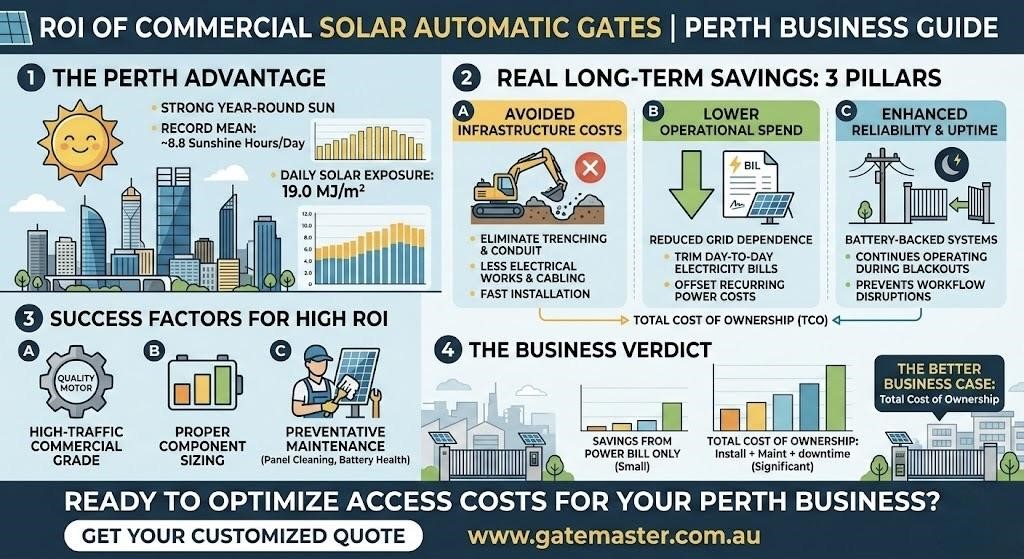
- Perth’s solar conditions are favourable, with Perth Airport recording an annual mean of 8.8 sunshine hours per day and annual mean daily solar exposure of 19.0 MJ/m².
- Payback is often faster on sites where trenching, conduit runs, or switchboard upgrades would otherwise be needed.
- Battery-backed systems can continue operating during blackouts if they are correctly sized for traffic volume and charging conditions.
- There is no widely advertised WA rebate aimed specifically at solar gate automation, but broader clean-energy and business funding programs may still be relevant.
Why automatic solar gates matters now
- Energy costs remain a live issue for Australian businesses, and WA is still expanding the rules and support settings around solar and batteries for homes and small businesses.
- That matters because access systems are no longer treated as minor add-ons; for industrial yards, depots, schools, strata sites and logistics facilities, they are part of daily operations. If the gate fails, workflow slows down immediately.
- A useful local benchmark comes from the City of Perth, which says its largest solar project is on track to save about $400,000 each year on electricity and recover its cost in four years.
- A gate system is obviously much smaller, but the same principle applies: once solar generation offsets recurring power spend, the savings compound over time.
Perth Industrial Gate Automation: Where the Real Long-term Savings Come From
The strongest return usually comes from three areas.
- First, a solar setup can remove or reduce the need to run mains power to a gate line. On commercial sites with long driveways, hardstand areas, or existing concrete, that can mean less trenching, less conduit, and fewer electrical works.
- Second, the gate’s day-to-day power draw shifts away from the grid.
- Third, battery-backed low-voltage systems can soften the operational hit of outages.
A well-planned automatic solar gate installation is rarely justified by electricity savings alone. The better business case is total cost of ownership: installation complexity, downtime risk, maintenance intervals, and the cost of manual workarounds when a gate is offline.
The hidden saving is often not the power bill; it is the avoided civil and electrical work at the start.
System Design and Maintenance Factors That Affect Long-term ROI
- For sites that need high-traffic commercial solar gates, component selection matters more than the solar label itself. Motor duty cycle, battery capacity, access frequency, and controller quality all affect reliability.
- A cheap system on a busy site can erase the expected savings through battery replacement and service visits, while a properly sized commercial-grade setup tends to produce a steadier return.
- Routine servicing still matters. Sensible solar gate maintenance plans should cover battery health, panel cleanliness, hinge or track condition, safety devices, and controller diagnostics.
- Solar reduces some operating costs, but it does not remove the need for preventative maintenance, especially in dusty, coastal, or high-use environments.
Quick comparison
| Factor | Standard mains-powered gate | Solar-powered gate |
| Upfront works | May require trenching and power runs | Often lower if off-grid placement suits site |
| Running power cost | Ongoing grid use | Lower direct energy cost once installed |
| Outage resilience | Depends on mains or separate backup | Can keep working with battery storage |
| Best ROI case | Gate close to existing power | Remote or hard-to-wire gate lines |
This is why solar tends to make the most financial sense at remote entrances, wide commercial frontages, and retrofit sites where bringing in power is awkward or expensive.
The best ROI comes from matching solar input to actual gate cycles, not from installing the biggest panel available. Oversizing the motor or undersizing the battery can be just as expensive as staying on mains power. In practice, Perth’s strong sun helps, but site shading, winter performance, and traffic peaks still need to be assessed before a purchase.
Also Read: The Role of Automatic Sliding Gates in Commercial Security in 2026
Choose a solar gate system that matches your site’s traffic, layout, and operating needs to get the best long-term return. For tailored advice and a reliable installation, speak with Gate Master about a site assessment and quote.
Frequently Asked Questions:
1. How much can a Perth business save with a solar automatic gate?
Savings vary by site. The biggest gains usually come from avoiding trenching, conduit runs and grid connection works, then reducing small ongoing electricity costs. On remote entrances, installation savings can outweigh energy savings in the first year alone.
2. What is the payback period for commercial solar gates in 2026?
A typical commercial payback is often around two to five years, depending on traffic volume, battery size, maintenance discipline and whether mains power would have required major civil works. Shorter payback is more common on hard-to-wire sites.
3. Do solar-powered automatic gates work during Perth blackouts?
Yes, if the system includes batteries and is sized correctly. Solar-charged battery setups can keep operating when mains power drops out, although runtime depends on stored charge, weather conditions and how often the gate cycles during the outage.
4. Are there WA government incentives for solar gate automation?
There does not appear to be a dedicated WA rebate aimed specifically at solar gate automation. Businesses may still find support through broader clean-energy or business funding programs, so it is worth checking current state and federal grant listings before committing.
5. Can solar gates handle high-frequency commercial traffic in Perth?
They can, provided the motor, controller, panel and battery bank are engineered for that load. Commercial performance depends on duty cycle and storage capacity, not just sunlight, so high-use sites need a specification based on real traffic patterns.
For Perth businesses, the best path forward is straightforward: assess the site, calculate avoided infrastructure costs first, and treat energy savings as the second layer of value. If the entrance is remote, busy, or expensive to wire, solar gate automation can be a sensible long-term operating decision.